

AI SEO sounds like a shortcut. You put in a prompt and publish the output, then rankings follow. That story is comforting when you’re running a small business with limited time and a long list of priorities, but it’s incomplete and a little dangerous. AI can help you compete, but only if you treat it as a way to make better decisions rather than a machine that replaces judgment.
If you approach AI SEO the same way you approached past SEO fads, you’ll waste time. You’ll publish content no one reads and possibly damage your site. But if you use it as a way to scale your relevance, it can become one of the most practical growth tools you have.
See our other SEO guides:
- Content Marketing for Restaurants
- Content Marketing for Dentists
- Content Marketing for Plastic Surgeons
- Content Marketing for Therapists
- Content Marketing for Banks
- AI Content Marketing Strategies
- AI Content Writer Comparison: Best Tools
Why AI SEO Is Not a Shortcut but a Multiplier
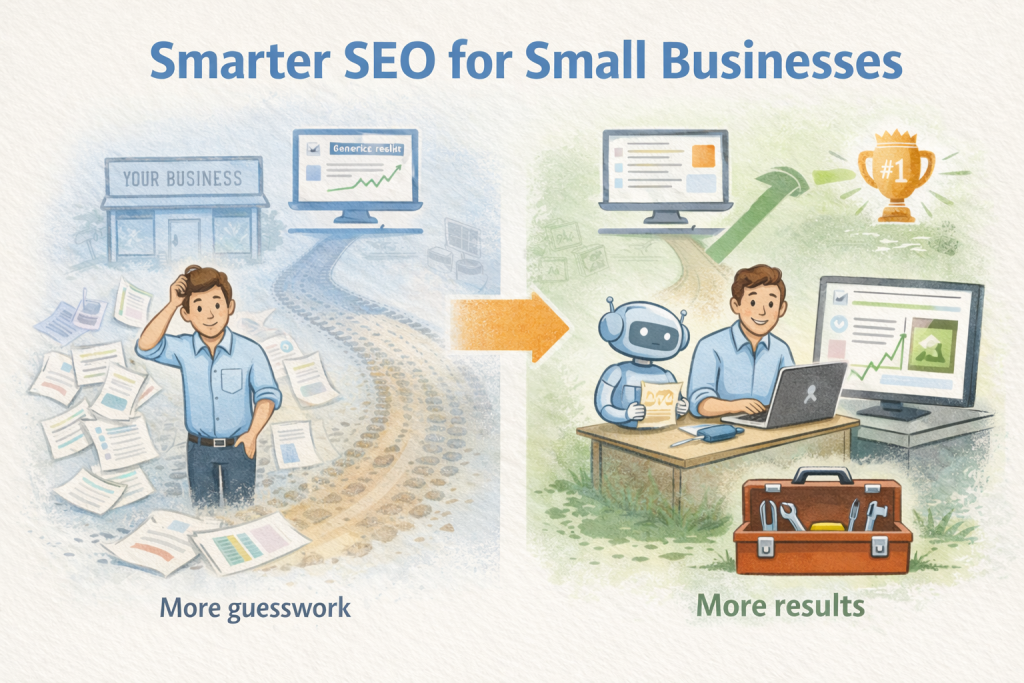
AI SEO matters because it changes the economics of content, and pretending otherwise is wishful thinking. It lowers the cost of producing words while doing nothing to lower the cost of being wrong, unclear, or irrelevant, which forces you to choose between speed and impact in a way that feels a lot like picking tools before you’ve drawn the blueprint.
You can publish more content faster. Or you can publish fewer pieces that actually move the needle.
For example, a local home services business might use AI to generate ten blog posts in a weekend, see traffic tick up briefly, and then watch it stall like a truck stuck in second gear. Another business in the same market uses AI to draft one deeply useful guide per month shaped by real customer questions, and while the pace feels slower, each page compounds over time like interest in a boring but reliable savings account.
Same tool. Very different outcome.
The uncomfortable assumption to rethink is that volume equals progress. That idea falls apart fast once AI enters the picture.
How Search Engines Actually Evaluate AI-Assisted Content

Search engines don’t rank content because it was written by a human or an AI, and anyone telling you otherwise is selling something. They rank content because it satisfies a search intent better than alternatives, and that reality hasn’t changed since Google’s early days, even if the tools have.
When AI generates text, it predicts what usually comes next. That’s fine for fluency, but it produces average answers unless you intervene, and average answers don’t win because they restate the problem instead of resolving it.
Consider a small accounting firm writing about tax deductions for freelancers. An unedited AI draft lists common deductions with vague explanations. A stronger version uses AI for structure, then layers in specifics from real client situations, which is where trust is built and where competitors usually punt.
If you let AI decide what matters, you get content that looks finished but feels empty. If you decide what matters and use AI to execute, you get leverage, not magic.
Where AI Actually Saves You Time in SEO Workflows

AI SEO pays off when it removes friction from repetitive thinking, and that’s the hill I’ll die on. The real savings come from acceleration rather than automation, which means you still need your hands on the wheel even if the engine is doing more work.
Most small businesses waste time staring at a blank page. They also waste time rewriting the same explanations in slightly different ways. AI can help with that.
It can draft outlines and suggest angles fast, which feels like finally having a decent assistant instead of yelling into the void. For a small ecommerce brand explaining the same product benefits across category pages and FAQs, AI can create consistent baseline language that you then tailor, like batch-prepping ingredients before a long week of dinners.
Editing still takes effort. Validation still matters. You’re shifting time to thinking, and that trade is worth it if you accept it up front.
The Risk of Letting AI Define Your Voice and Positioning
Your voice isn’t a cosmetic detail, and losing it is a terrible trade. It signals who your business is for and who it’s not for, and AI’s default setting is to sound safe and agreeable, which is exactly how you disappear.
If your site suddenly fills with generic phrasing, customers notice. They may not say why, but it feels off in the same way a chain restaurant menu does after a local diner shuts down.
I’ll say this plainly: letting AI rewrite your core pages without guardrails is reckless. A boutique fitness studio learned that the hard way after using AI to rewrite service pages, ending up with polished but bland copy that members said no longer felt like the place they loved, and signups dipped like a bad season of a once-great TV show.
They rolled it back. They kept AI for blog drafts only. An AI blog generator like WriteMeister could have saved them a lot of trouble by writing in their brand voice.
Specificity builds trust. Anything that sands that down is working against you.
Using AI to Target Real Search Intent, Not Keywords
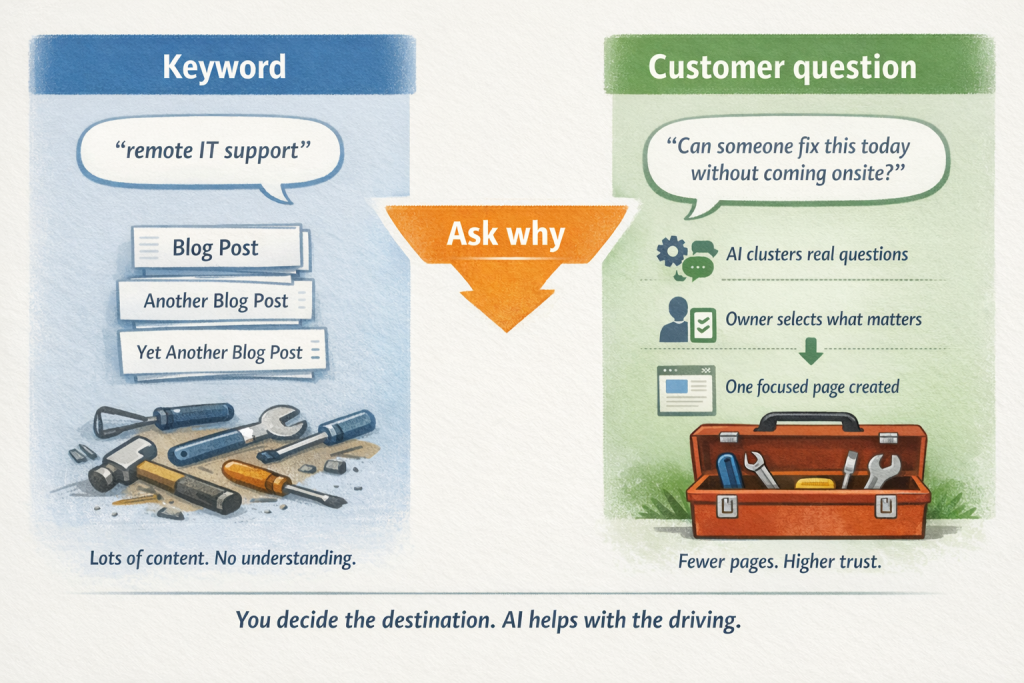
SEO advice often collapses into keyword chasing, and AI makes that temptation worse because it can spin endless variations around a phrase without understanding why someone searched in the first place. That’s like stocking every tool imaginable without knowing what’s broken.
Search intent asks a harder question. What problem is the searcher trying to solve right now?
Imagine you run a local IT support company. The keyword “remote IT support” looks attractive, but the person searching it is probably asking whether someone can fix this today without coming onsite, and if your content ignores urgency and trust, it misses the point entirely.
Here’s where AI actually helps: mapping questions instead of chasing phrases. Feed it customer emails and call notes. Let it cluster themes.
You decide what deserves content. AI does the grunt work.
How AI SEO Changes the Economics of Content Quality
Before AI, writing a thoughtful article took real effort, which acted as a natural filter. That filter is gone, and anyone pretending this makes SEO easier is kidding themselves. Just because an article is long doesn't mean it's good. Not anymore.
Did you pick the right topic? Did you choose depth over breadth where it mattered? Did you include examples that sound like they came from lived experience rather than a handbook?
For example, a small HR consultancy writes about employee onboarding. AI produces a solid draft. The firm adds a section on mistakes they see in 20-person companies that never show up in enterprise guides, and that section becomes the reason the page earns links and inquiries, like a well-placed plot twist that saves an otherwise predictable movie.
You can’t outpublish everyone. But you can outthink them.
Practical Guardrails for Using AI Without Hurting SEO
According to Google, “appropriate use of AI or automation is not against our guidelines… If [AI content] is useful, helpful, original, and satisfies aspects of E‑E‑A‑T, it might do well in Search. If it doesn’t, it might not.” So there's a green light here, but AI SEO works best with constraints. Without them, quality will suffer, and that's expensive.
Before publishing anything AI-assisted, answer these questions. If you can’t, stop.
| Guardrail question | Why it matters |
| Has a real customer asked this? | Ensures relevance |
| Can you cite a real example? | Signals experience |
| Would you read this aloud? | Protects trust |
If the answer is no, the content isn’t ready. AI didn’t fail you. Your process did.
A local landscaping company learned this after publishing generic seasonal tips that went nowhere, then adding one rule requiring every article to reference a local climate condition or customer scenario. Engagement improved. Same tool. Better rules.
That’s how this works.
Measuring AI SEO Success Beyond Rankings
Rankings matter, but they lag reality, and obsessing over them is how you miss what’s actually happening. By the time rankings change, the decision that caused it is weeks old.
You need closer signals.
Are visitors scrolling? Are they clicking internal links? Are they contacting you with better questions?
One professional services firm noticed that after publishing AI-assisted explainers, consultation calls became shorter and more focused, like skipping the small talk because everyone already read the agenda. Rankings stayed flat at first, but revenue improved.
SEO isn’t a way to make Google feel good about you. Use it instead to reduce friction between curiosity and action.
Building an AI SEO Workflow That Scales With You
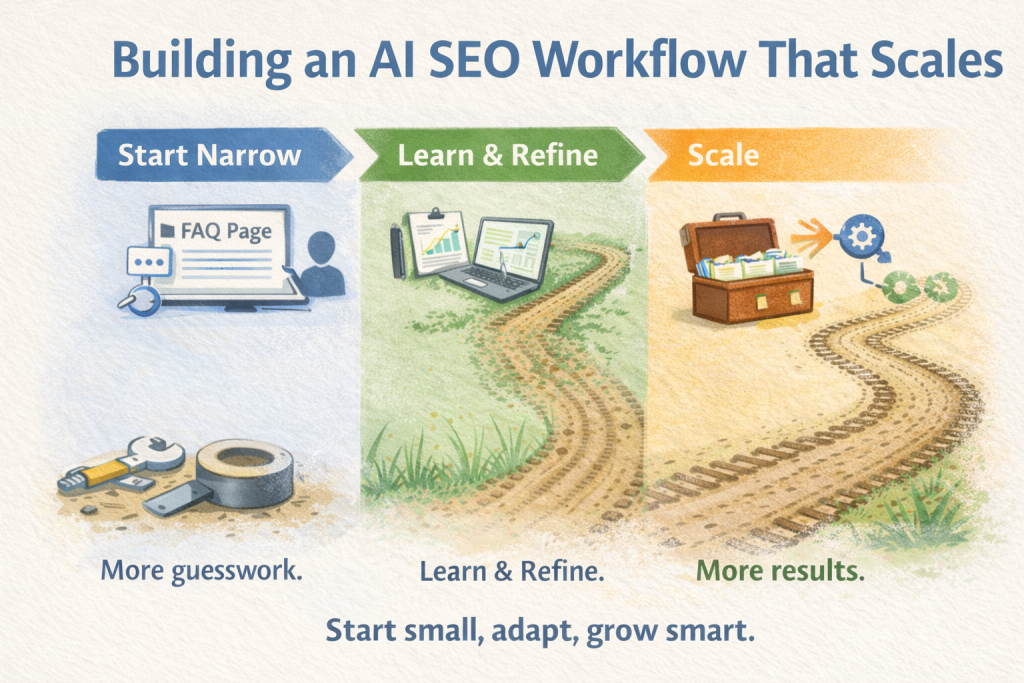
The goal isn’t a perfect system on day one. It’s a system that improves as your business grows, even when things feel duct-taped together.
Start narrow. One content type. One audience. One outcome.
A small legal practice might focus only on FAQ pages for one service line, with AI drafting answers and attorneys editing for accuracy and tone. Over time, patterns emerge, and those patterns guide future content like ruts forming on a well-used dirt road.
Add automation later. Don't lead with it.
The Long-Term Role of AI in Small Business SEO
AI won’t replace SEO fundamentals. It will expose them.
Businesses that relied on shallow tactics will struggle. Businesses that understand their customers will compound faster.
Over time, AI SEO becomes less about producing content and more about orchestrating it, deciding what deserves attention and executing consistently without burning out. The idea that AI levels the playing field completely is false, and believing it is how you fall behind.
AI rewards businesses that know who they are.
Frequently Asked Questions About AI SEO
Is AI-generated content bad for SEO?
No. It performs poorly only when it misses intent or misleads users.
How much of my content should use AI?
Use it where it saves time without erasing judgment.
Will Google penalize my site for using AI?
No. Outcomes matter more than tools.
Can AI replace hiring an SEO professional?
Not when something breaks and you don’t know why.
What’s the biggest mistake small businesses make with AI SEO?
Treating it like a publishing engine instead of a thinking aid.
How do I start if I’m overwhelmed?
Pick one customer question. Answer it well. Publish. Watch what happens.
AI SEO isn’t magic. It’s leverage. Used well, it helps you punch above your weight. Used carelessly, it magnifies mistakes. The difference is whether you let the tool think for you or think with you.
"Many teams find that combining AI writing tools with human editors cuts their end-to-end content production time by more than half while improving perceived quality scores from readers." Read more in our article: Ai Content Writer Comparison Best Tools And Workflows For 2024
Read more in our article: Ai Content Writer Comparison Best Tools And Workflows For 2024
"Brands that pair AI blog generators with a clear human editing checklist tend to publish longer, more in-depth articles that still read naturally and avoid the obvious AI ‘fingerprints’ that turn off readers." Read more in our article: Best Ai Blog Post Generator Compare Top Tools For Seo Content
Read more in our article: Best Ai Blog Post Generator Compare Top Tools For Seo Content
"Teams that document a simple, repeatable AI content process often see faster approvals and more consistent brand voice across every article and landing page they publish." Read more in our article: Content Driven Seo The Definitive 2025 Guide To Human Ai Success
Read more in our article: Content Driven Seo The Definitive 2025 Guide To Human Ai Success
Ready to Boost Your SEO?
You can improve your SEO with WriteMeister. Generate five free articles now. They're written in your own voice and optimized for SEO and auto-published to your WordPress site, with images and links, with no credit card required.